
The House Frances Built

Well, I am once again here to tell y’all about how I started researching some random person and ended up falling down an incredibly deep rabbit hole that then connected to everything else I’ve been learning about in fascinating and unexpected ways!
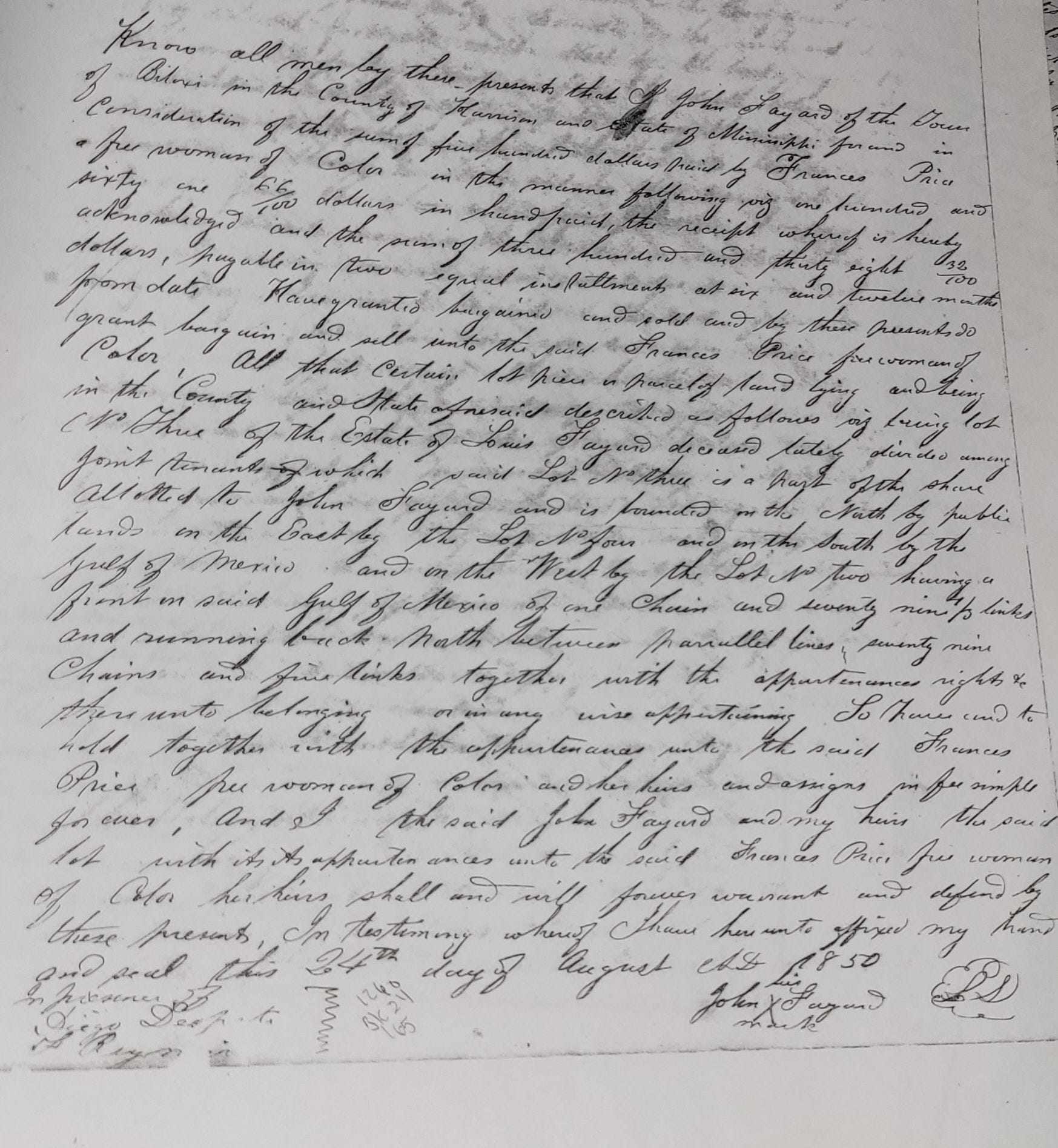
So I saw a Facebook post in my feed from a random Mississippi Gulf Coast genealogy group I wasn’t even a member of. Someone in that group shared this document, a deed of sale from 1850 for some beachfront real estate in Biloxi. Frances Price, a free woman of color, purchased the property from the estate of Louis Fayard for $500.
From the original poster:
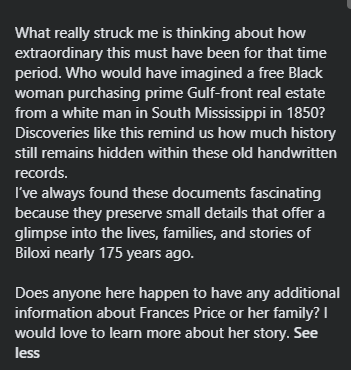
This was, of course, irresistible to me, so I went and started poking around in full-text search on FS to see if I could find anything about her. I quickly located another deed from June 1855 where Frances transferred the same Biloxi property to Charles A. Labuzan for $4000.
The next documents I found Frances on were her death record (very shortly after she sold that property), probate file, and will.
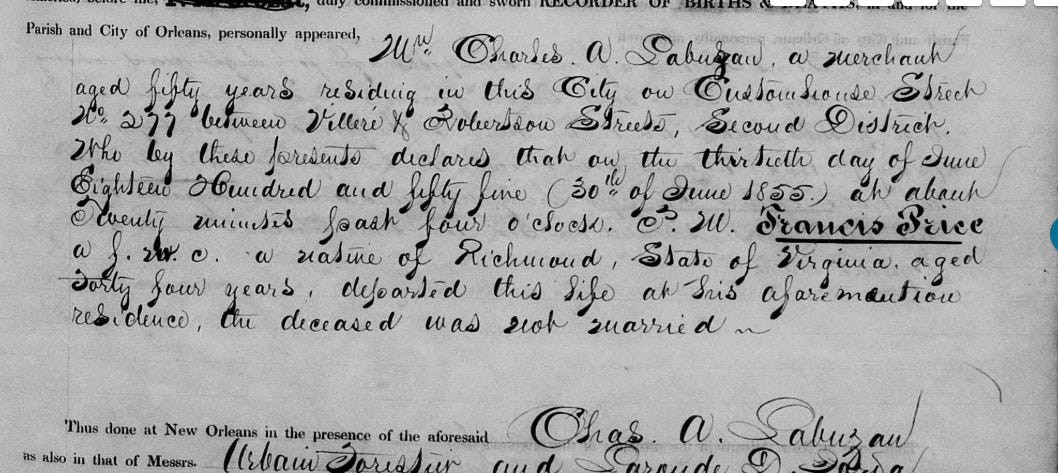
Frances was a native of Richmond, Virginia; she was about 44 years old when she died. The most interesting part of this record is that she died at the home of Charles A. Labuzan, the same person she sold her Biloxi property to.
From Frances’s will, we learn she had four “natural” children between 10 and 21 years old. She directed that all of her estate go to them and named Charles A. Labuzan executor and tutor of the minor children. That is because they were also his children; all four were Labuzans. Frances was buried in “Charles Labuzan’s vault”. It’s unclear if the vault was really “his”, as everything else certainly seems to have belonged to Frances; she owned the house they lived in and most of the things in it. She also owned five slaves in 1850 and two at the time of her death. On the 1850 census, the only person in the household with anything in the “value of real estate” column is Frances. Charles and their four children are also there; Charles was apparently a U.S. deputy marshal and was born in Georgia.
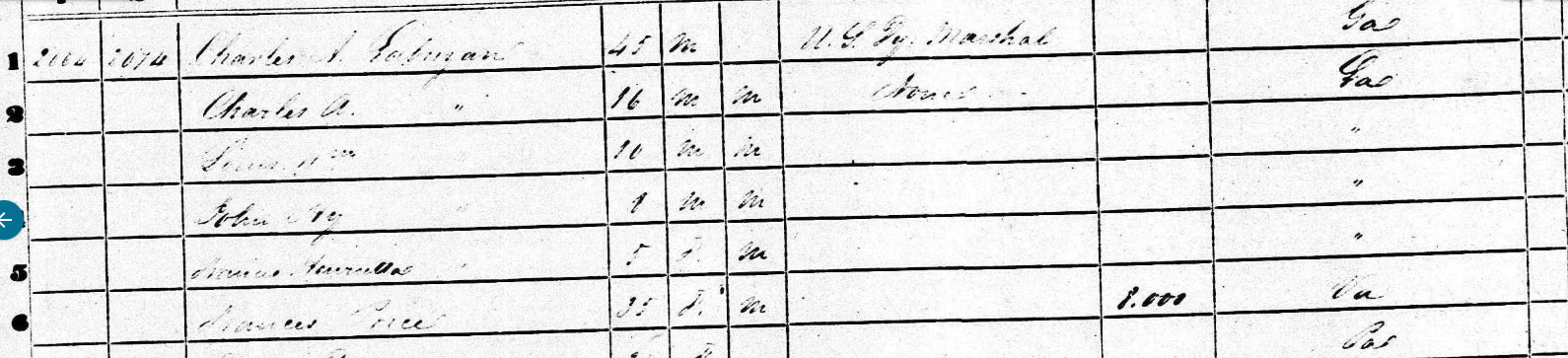
Another interesting thing on that census is that Frances and all four children are marked “M” for mulatto, and Charles has a blank there. Looking at the other entries around this one, this census taker seems to have just treated white as the default and marked no one “W”. Only those not considered white had a letter there. This is similar to what I’ve seen so far on other documents, where Frances is consistently noted as a free woman of color, while Charles is not labeled with any race, presumably white. They would not have been legally able to marry, hence the “natural” children despite a clearly long-lived relationship.
All of this is pretty interesting all by itself, but I wouldn’t have felt the need to write a whole post about it. 😊It was interesting enough to me that I wanted to know more about these people. How did they come to New Orleans? Where did they meet? Was Frances born free, and if not, who enslaved her, and how was she emancipated? What kind of name is Labuzan, anyways?
So I started researching Charles Labuzan.
I learned Charles was born in Augusta, Georgia. He served in the Mexican War, and he went to live in New Orleans about 1832. His first child with Frances was born in 1834. When the Civil War broke out a few years after Frances died, Charles served as brigadier general in the Louisiana Legion. This was a citizen unit that predated the war by several decades and was sort of a “home guard” type of organization, apparently mostly consisted of “foreigners”. The Legion was eventually made to disband so the members could join regular military units.
After the war, when most of his children would have been married already, he married for the first time to Sarah Ellen Moody, a native of Manchester, England. They had one daughter born to them named Isabella (who eventually ended up in Texas), and Charles died six months after the birth. He was 62 years old. Only his legitimate daughter was mentioned in his obituary. Although most of Frances’s children were in Charles’s household on the 1860 census, I have not yet tried to find them beyond that. I also haven’t found any probate documents to enlighten me on what happened with his existing children or what their relationships may have been like.
But I still wondered, why’d Charles go to New Orleans? Who are the Labuzans? I’d never seen that surname in my life. It turns out they’re one of those blessed families where the surname is so rare, I never did find a person with it that wasn’t related to Charles in all my time researching them. It turns out the easiest way to understand this family is comprehensively; I could tell that the surname was incredibly rare and that all the Labuzans I was finding in all kinds of places were connected to each other, but I couldn’t really see how until I had gathered up all the details I could find and looked at them all together. There were no straightforward birth/marriage records showing relationships, in a lot of cases.
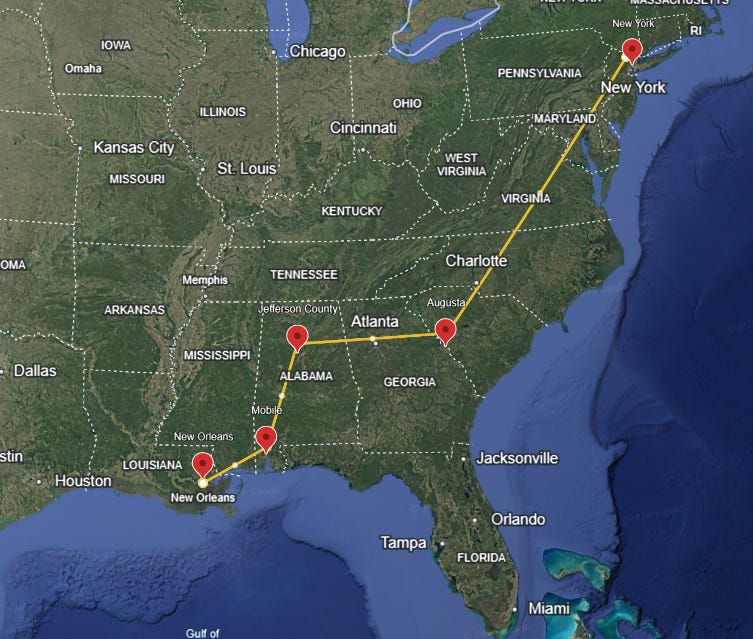
This is the path the Labuzans took in the United States, broadly, down to Charles’s generation.
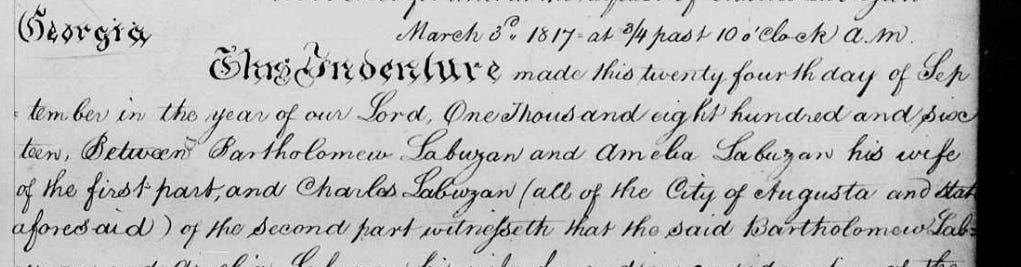
I’m not going to attempt to take you through my reasoning on this as it evolved, we are just going to skip to the part where I can explain this family’s story in a linear, sane manner. 😂 But in New York City in March 1817 some property-related documents were recorded at the request of one Charles Labuzan. The first part of this (very long but thankfully nicely written) bunch of documents related to the Labuzans is an indenture made on 24 September 1816 in Georgia between Bartholomew Labuzan and his wife, Amelia and Charles Labuzan, all of Augusta, Georgia.
Bartholomew and Amelia were transferring the property Bartholomew had inherited from his father, Bartholomew Labuzan of New York, who was deceased, to Charles. The property was in New York City, bounded by Third Street, Pump Street, and another property that was bequeathed to Ann Labuzan by Bartholomew, senior. Bartholomew, junior, was also transferring all of the property his father had bequeathed to Anthony Labuzan (same general area but bordering on land that had gone to Charles). Anthony Labuzan had conveyed his portion to Bartholomew.
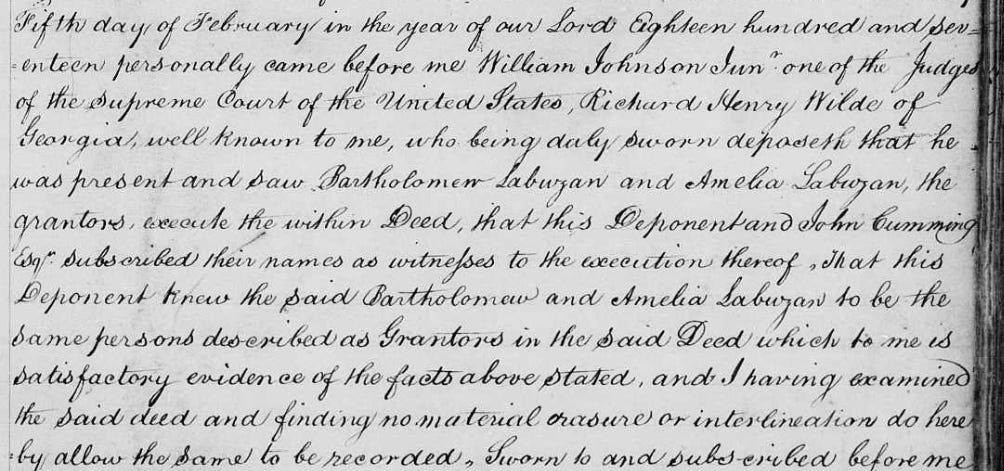
For some reason, this went before a judge in the Supreme Court of the United States in February 1817. John Cummings, Esq. testified that he knew Bartholomew and Amelia and they were the same people who were described in this document. The judge affirmed its validity.
The next document is another indenture between Anthony and Bartholomew. It describes Anthony as formerly of New York, but now of Augusta. Anthony had also inherited property from their father, Bartholomew. Apparently Anthony and Charles used to be in business together and had borrowed $3000 from Joseph Corre of New York, the guardian of their brother, Bartholomew. (Sister Ann Labuzan married a Vincent Corre, likely a close relative.) The money came from the part of their father’s estate that Joseph Corre managed and rightfully belonged to Bartholomew, and Anthony and Charles mortgaged their respective properties to secure the loan. Anthony and Charles had then dissolved their business partnership, and while Charles repaid Bartholomew his half of the loan, Anthony never had. Not only had he not paid, he had actually borrowed more money and now owed Bartholomew more like $4500. Bartholomew had offered to consider the debt repaid if Anthony gave him the share of their father’s real estate that he had received. That is what happened, and this agreement, too, was validated by the Supreme Court.
So this group of property records confirms that the New York City Labuzans and the Augusta, Georgia Labuzans were the same family. Bartholomew, Charles, and Anthony all moved to Augusta probably sometime between 1805 when their father died and 1817 when these documents were recorded.
A recurrent theme in documents I’ve found about these brothers is that Anthony consistently seems to have had financial difficulties and trouble with debt. In addition to the above, his father’s will acknowledges that he had already “expended for my son Anthony sums of money to a considerable amount and the rights of my other children require that some deductions should be made” in the distribution of his property. Therefore, he gave each of the other three children $1000. There are some documents from New York City prior to the move to Augusta that show Anthony was arrested over his debts at one point. And when he died in Jefferson County, Alabama, about 1826, his probate was opened and the executor stated that his estate was “totally insolvent” and unable to pay its debts.
Now, the only part of this chain of descent I can’t fully document is which of these Labuzans was definitively the father of Charles Augustus who eventually moved to New Orleans. I know that he belongs in this family because of the incredibly rare surname and the mountain of corroborating evidence about this family and their distinctive migration path. I know that Charles Augustus had a brother, Louis Anthony, who died in New Orleans in 1839.
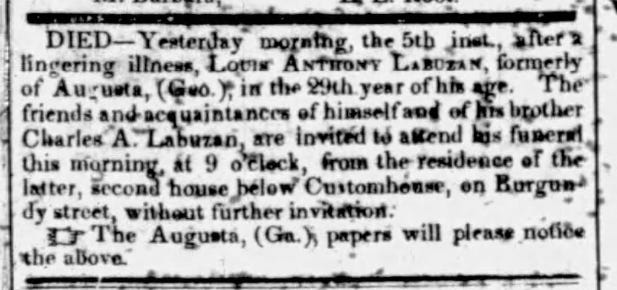
I can make a quite confident educated guess that Charles Augustus’s father was Anthony Labuzan, however. His brother being named Louis Anthony is significant; Louis was the name of Anthony Labuzan’s father-in-law. This family were big users of the pattern where sons were often named after their father and maternal grandfather. We see it in the son of Charles, Charles Robert Labuzan, whose maternal grandfather was named Robert.
Additionally, I can rule out some other Labuzans; Charles (the eldest Charles, son of Bartholomew senior) is traceable on censuses; he had another son named Charles who was a different person. Therefore he’s unlikely to have been Charles Augustus’s father. That leaves only two other brothers, Bartholomew and Anthony. It is possible that I’m wrong and Bartholomew was Charles Augustus’s father; but even if that is the case, Bartholomew and Anthony married two sisters, so the final tree for Charles Augustus would hardly change at all; he’d still have the same four grandparents regardless. Pretty much everything I’m going to go into next would apply regardless of whether Charles Augustus’s dad was one brother or the other.
So, these sisters that the Labuzan brothers married. Who were they? This is the part where things get really interesting, so buckle up!
The sisters were named Juliet Ann (married Anthony) and Amelia Formon Boisclair (married Bartholomew). Anthony married Juliet Ann in New York City in 1802; Bartholomew married Amelia in Augusta in 1814. They were the daughters of Louis Formon Boisclair and Marie Rose Cambry.
Louis Formon Boisclair was baptized in Couëron, France (near Nantes), in 1751. He was the son of Michel Formon, sieur de Beauregard and his wife, Dame Jeanne Mariot.
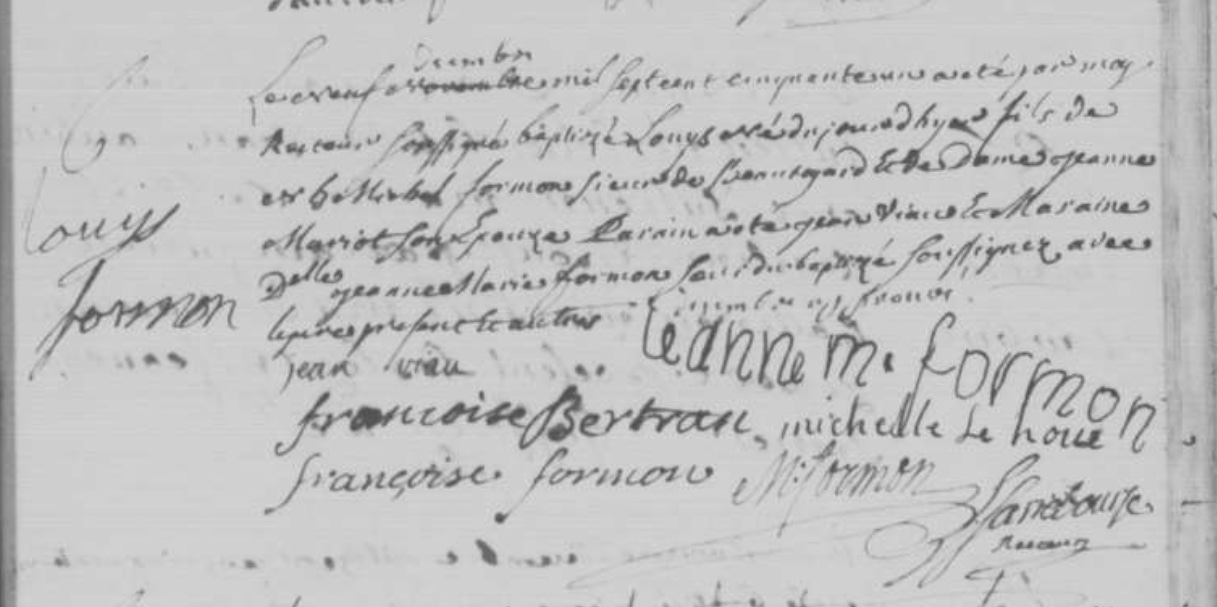
His wife, Marie Rose Cambry, was a native of Torbeck in Saint-Domingue. 😊 Louis’s will clarifies the relationships.
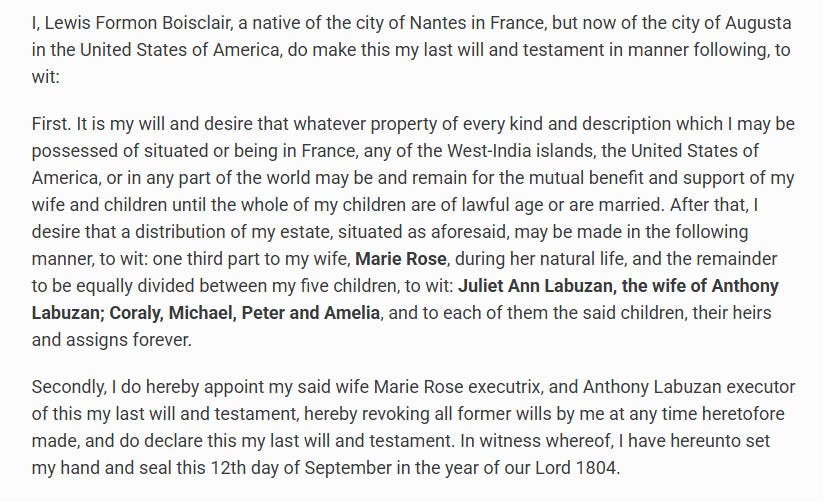
Louis and Marie Rose married in 1804 in Augusta, Georgia, actually after the marriage of Anthony and Juliet Ann. However, their relationship likely predated the family’s arrival in the United States. Louis’s brother, Pierre, married in Torbeck in 1777.
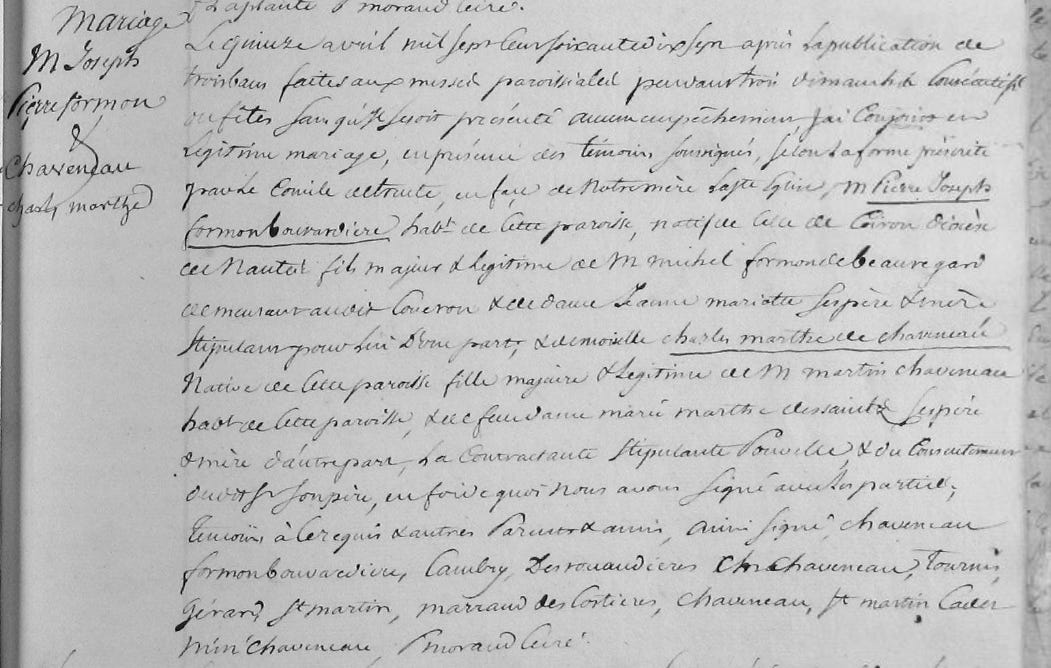
And you can see a Cambry in the list of witnesses at that marriage. It’s likely that Louis was also in Saint-Domingue prior to the Haitian Revolution, and the family left, first going to New York City before relocating to Augusta.
Why no marriage record for Louis and Marie Rose? Because Marie Rose was an emancipated former slave, a free woman of color, and their relationship was not legally sanctioned. A very well-sourced tree on Geneanet references just one document related to Marie Rose beyond her marriage and children:
Mistive ayant un acte de liberté du 3 août 1789 (enregistré au greffe de l’intendance de Saint-Domingue).
Mistive holding a deed of manumission dated August 3, 1789 (registered at the registry of the Intendancy of Saint-Domingue).
I have not seen this document myself, but I believe it exists.
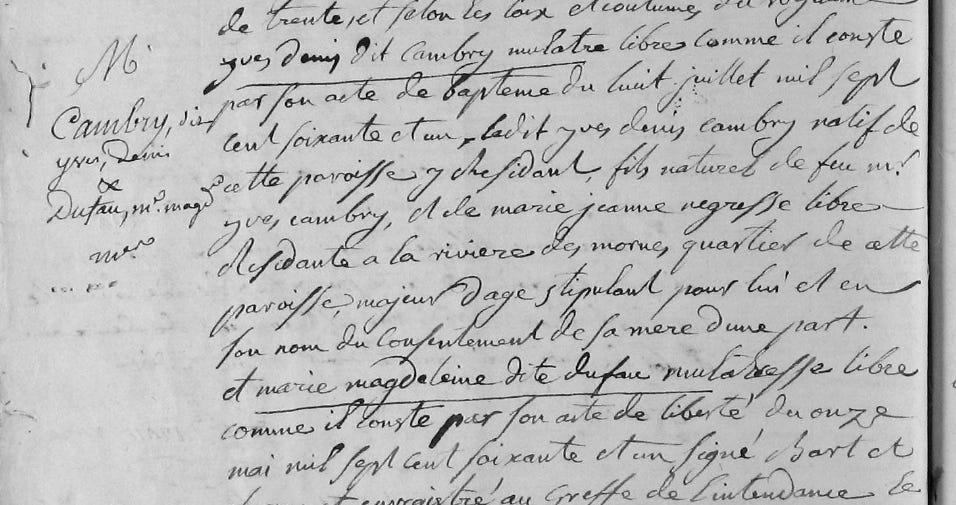
I looked all over Torbeck and elsewhere in the Saint-Domingue registers for Cambrys; without exception, the Cambrys I found were “mulatto” children of Yves Cambry. Marie Rose was likely either another child of Yves or perhaps his grandchild. Clearly she was white passing, and most of her ancestors would have been white; her mother, at least, however, was enslaved. I did not find any other Cambrys but these, period. There are Cambrys living today who are black Haitians. The surname persisting into modern times is actually pretty unique in Haiti, where the most common surnames are overwhelmingly things like Jean, Pierre, Joseph, and Louis, from the common practice of adopting a father’s first name as a surname when not able to take on his surname due to legal restrictions. Yves Cambry, however, appears to have recognized his illegitimate children. They used and continue to use his surname. This is the marriage record for a son, Yves Denis dit Cambry, mulatre libre, natural son of the late Mr. “Yve Cambry” and Marie Jeanne, negresse libre.
Most of the references I’ve seen to Yves Cambry have been in relation to his children, all free people of color. He’s also mentioned in some business-related documents in Saint-Domingue that I didn’t dive too deeply into. Then there’s this:
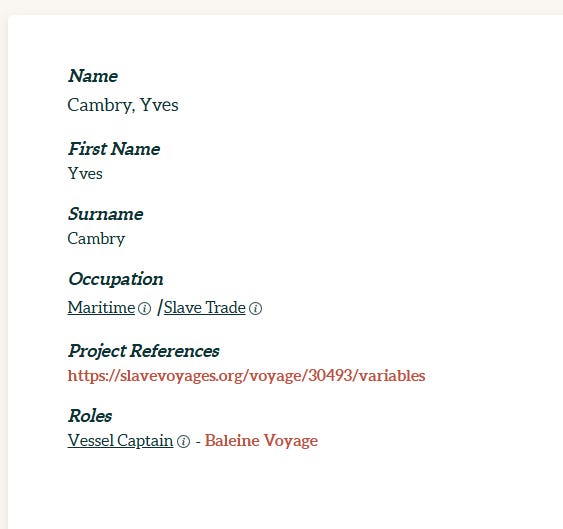
This is from enslaved.org. Apparently, an Yves Cambry was the captain of a slave ship called Baleine. The source for that:
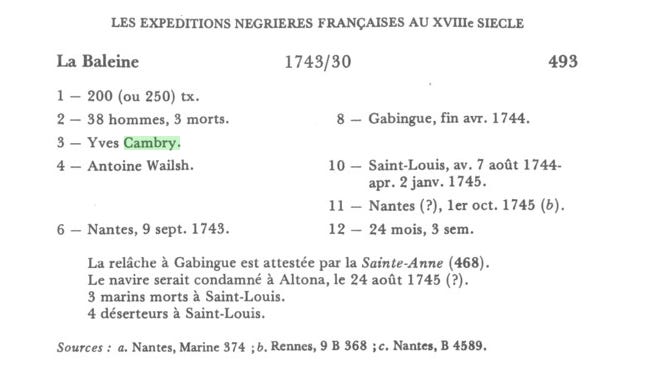
La Baleine sailed from Nantes in September 1743, headed for “Gabingue”, interpreted as Cabinda, Angola, by the slave voyages database, and arrived there in April 1744. In August they set out for Saint-Louis, meaning Saint-Louis-du-Sud in Saint-Domingue. 3 out of 38 crew members died and 4 deserted in Saint-Domingue. The captain seems to have been one of them. Something seems to have gone very wrong on this trip, as it took a very long time, has a lot of uncertainty in the dates, and ended in the ship being condemned when it finally made it back to Nantes fully two years after setting out.
According to the slave voyages database, 351/386 of the African slaves embarked in Cabinda disembarked in Les Cayes.
When I went to learn more about La Baleine, I realized I’d been here before…
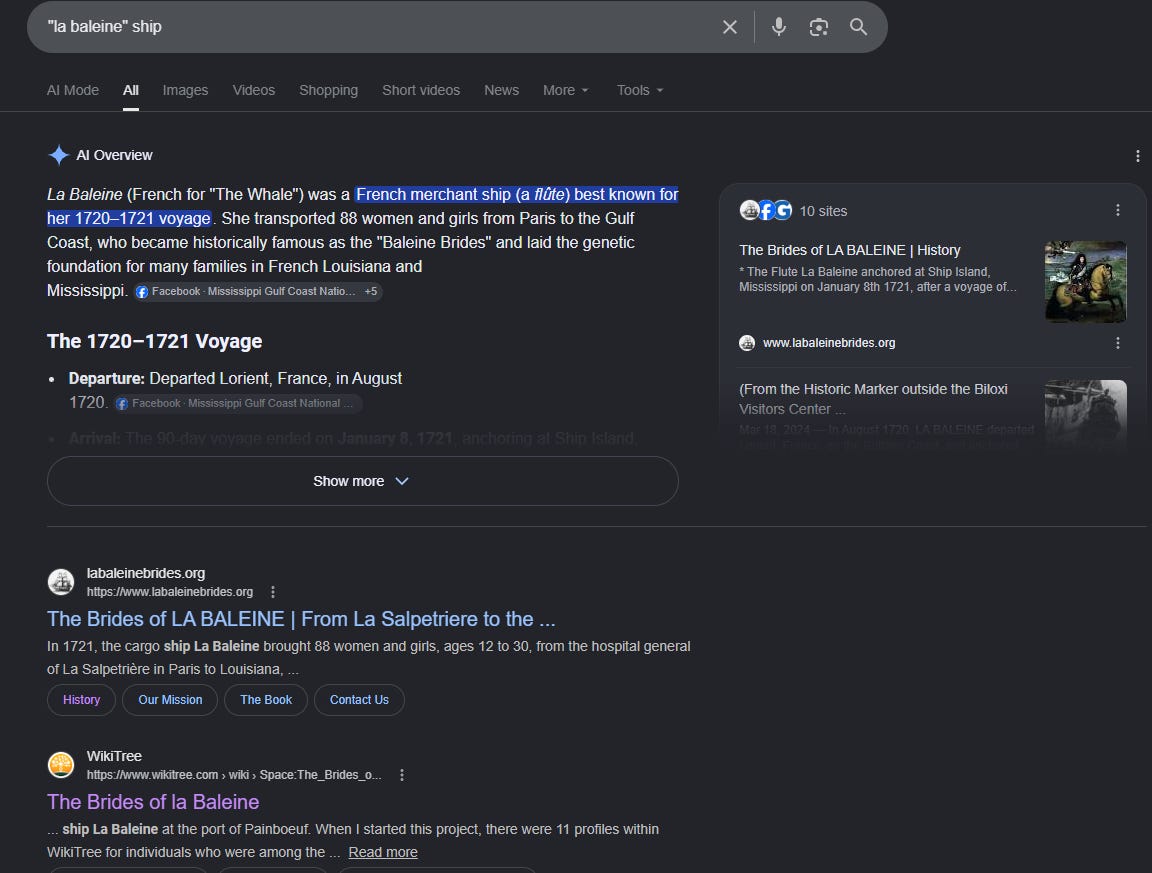
Yep. This is the name of ship that brought the famous “casket girls” supposedly brought to Louisiana so the white colonists would have potential white brides. That includes some of my ancestors. They were landed in Biloxi, my hometown and where this article started, in 1721.
So… then I wondered if this was the same ship. Wouldn’t that be nuts? Per Wikitree’s detailed article about this:
On January the 8th, 1721, the French flute BALEINE anchored at Ship Island, nine miles off the coast of present-day Biloxi, Mississippi.
So I searched this ship database site that collects information about all kinds of ships, their voyages and associated people.
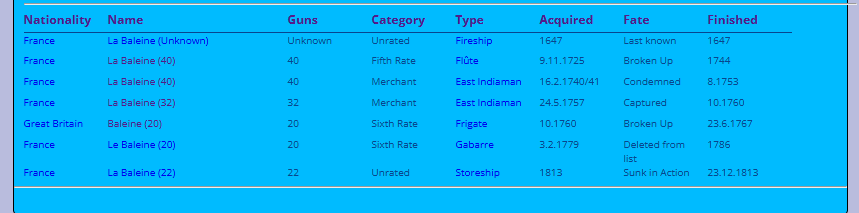
Only one on there is described as a “flute”. And it was “broken up” in 1744 just like Yves Cambry’s ship.

So… okay. I’m going to go ahead and say that I think this was the same ship, let’s unpack some of the details here. First I went ahead and looked into the petty officer named as a crew member in 1738, Antoine Nicolas Choiseul-Beaupré (Comte de Marcheville). I found a likely candidate on Wikitree for this person, but actually I didn’t find him by searching for Choiseul-Beaupré. I found him when I was searching for Antoine Walsh, who was named on the record related to Yves Cambry and La Baleine. The slave voyages site labels him “investor”.

I know that Antoine “Wailsh” or “Wailch” as rendered in these sources was referring to a specific historical figure, because I have learned about him before when I was working on something else.
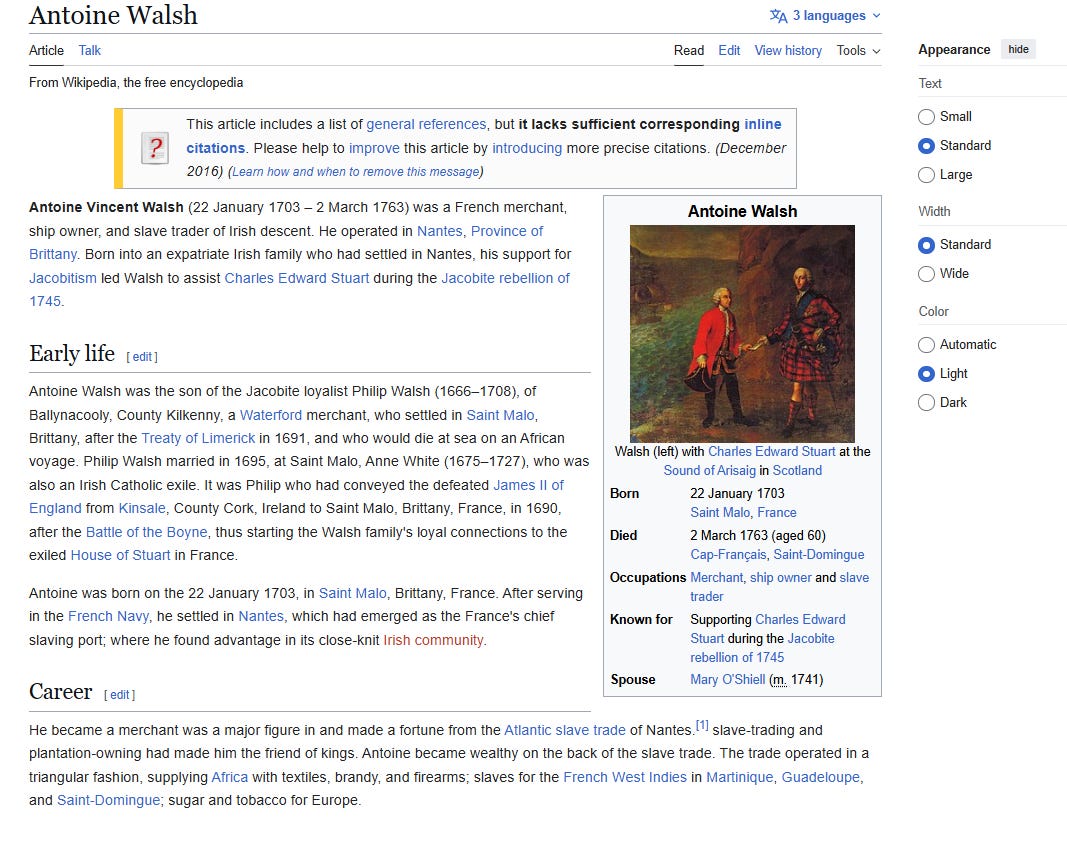
What something else? The O’Duhiggs…
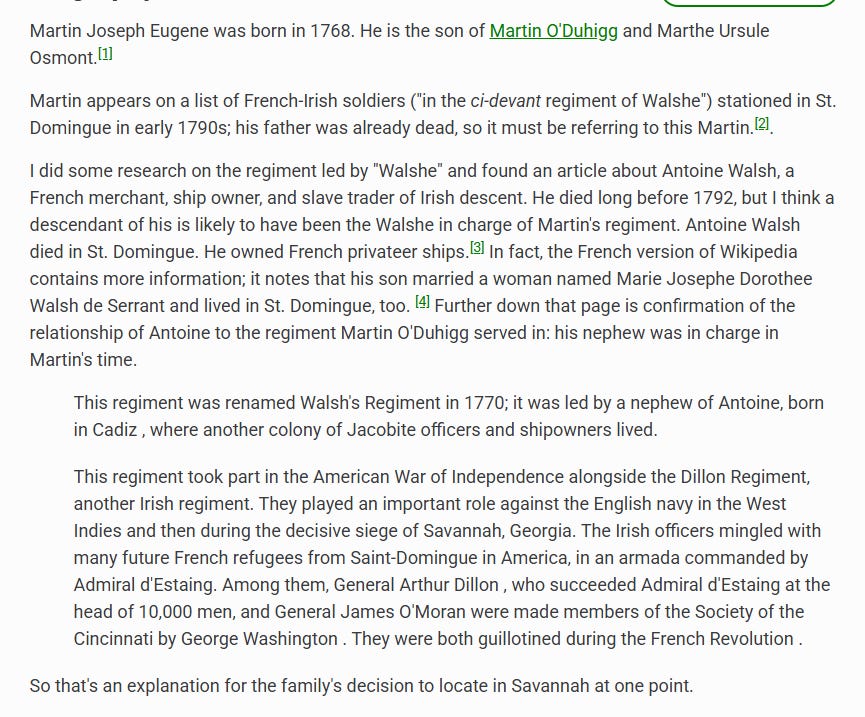
… that Irish family who lived in Saint-Domingue prior to the Haitian Revolution. In Torbeck. Francis O’Duhigg later was Edward Livingston’s overseer at his Plaquemines Plantation. Francis was also the estate administrator and neighbor of the Pierre Gautier who died there in 1805. That’s why I wrote this profile for Martin O’Duhigg over a year ago which mentions Antoine Walsh, whose nephew was apparently in charge of O’Duhigg’s military regiment. 😂
And when I searched for Antoine Walsh on Wikitree I found this guy, too young to be the one on Wikipedia, but married to…
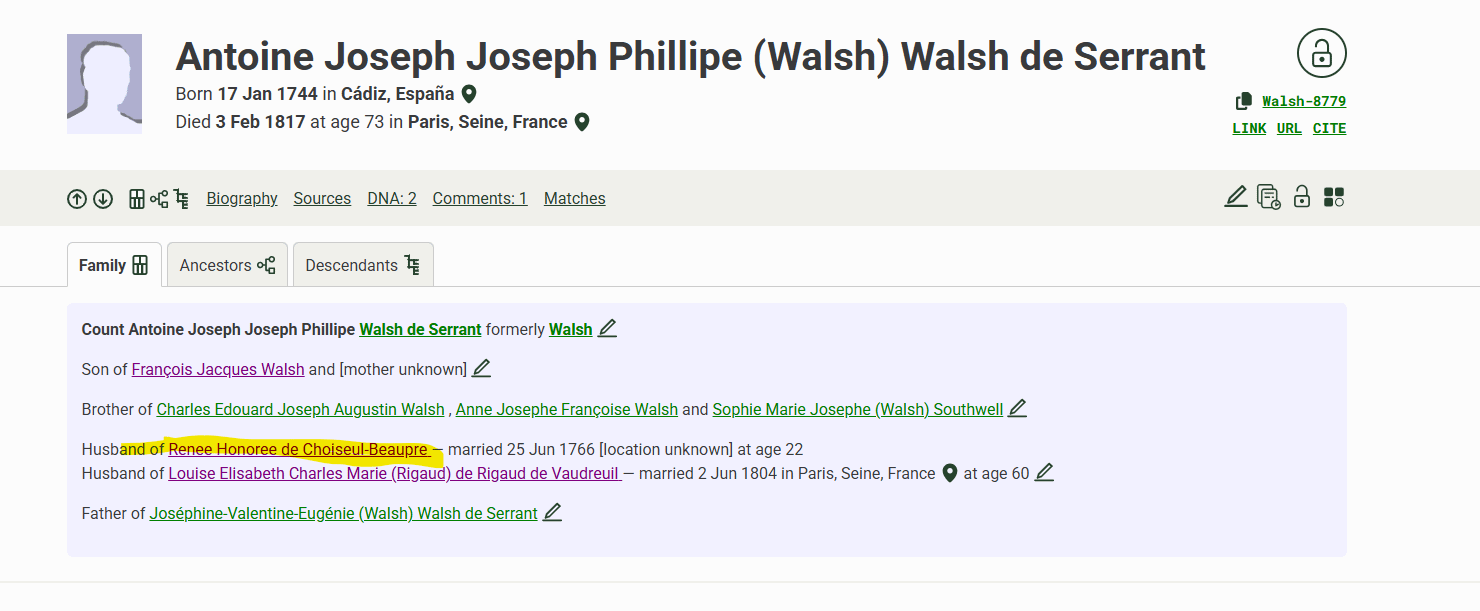
a Choiseul de Beaupre.
I am so serious when I say that it does not matter what I start to research, I’m getting led back to the same things, the same people and places. It’s actually starting to feel absurd, but what can I do? This is where the evidence went. 😂
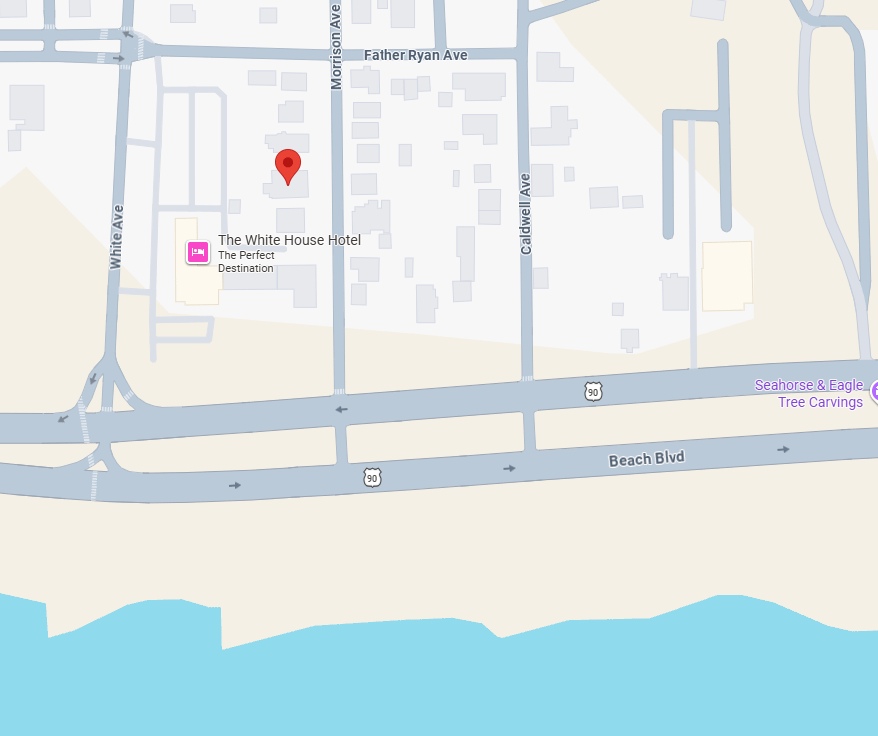
There’s a historical marker in Biloxi where the house that was built on Frances Price’s property now stands. It was originally on the property that is now the White House Hotel but was moved to a different location.
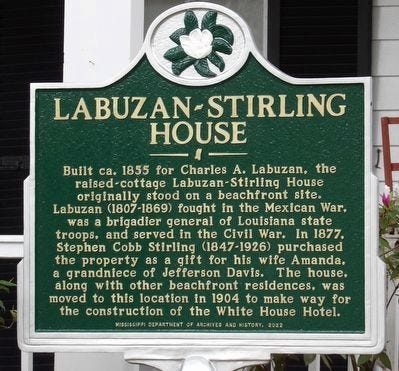
Charles Labuzan is named on this plaque, but Frances is not mentioned anywhere. But it was Frances’s property and, in all likelihood, Frances who was having the house built. She bought it in 1850 for $500 and sold it just before her death to Charles for $4000. She owned their house in New Orleans. And then the same year Charles became the owner of this property (1855) the house was heavily damaged by a hurricane.

The house:
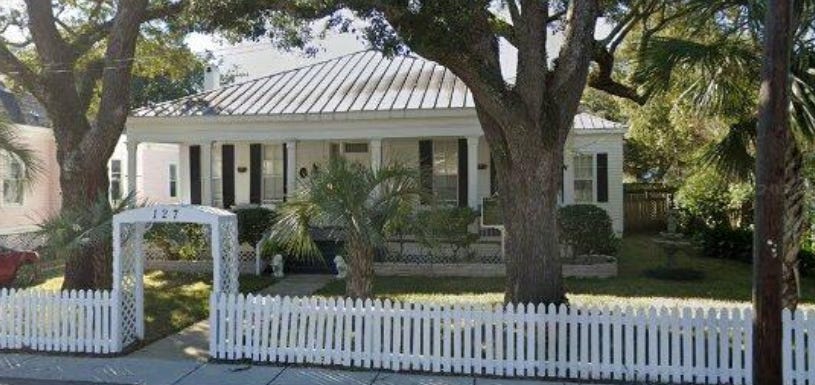
If it moved, it wasn’t moved far. The White House Hotel is on what was probably part of the same property at one point. The red pin is the house’s current location.
This Labuzan family is the only one I’ve come across looking for them very broadly. Almost all of these people, no matter their recorded or actual race, owned slaves. These people were, without exception, recorded as white on every document about them in America. (Okay, I lied; the exception is the children of Charles and Frances Price. But while she and his kids were free people of color, Charles was clearly considered white.)
I wasn’t able to learn more about Frances, although I may yet find more on her, too. I want to know more about her and how she and Charles ended up in New Orleans. She’s harder to trace because she (and surely, her parents) were treated as people of color. If Frances was born enslaved, I’ve seen no record to show it. It’s definitely possible. It’s also possible she was also the child or grandchild of a family that fled Saint-Domingue and were in Richmond, Virginia when Frances was born. Both could be true. Or she could have a completely different story.
I think all of this serves as a fantastic example of just how much different these stories tend to be from what you may have assumed. It started out as interesting because a free woman of color bought property in Biloxi in 1850. That is interesting in itself. But keep pulling on that one interesting thread and next thing you know… this😂
There are a lot of white people in places like Alabama, Texas, and California who have mysterious brick walls in their trees that go directly back to this same Labuzan family. Maybe some of them are aware of their family’s history; if they are they’ve not shared much. The well-sourced tree I found stopped at Louis Formon Boisclair and Marie Rose Cambry, it was coming from the other direction (earlier) and belonged to a French person. I didn’t find any well sourced trees related to Bartholomew Labuzan’s descendants or the Formon Boisclair family in America. There were some that had most of the names in them, always without any sources at all. They don’t broadly agree with each other in a lot of important ways. And lots of descendant trees that stop at Charles Augustus’s generation or maybe one earlier, seemingly brick walls.
There was a famous emancipated slave named James Boisclair whose story and name strongly suggest he was also a relative of this family. He wouldn’t have taken that name for no reason, and he was last owned by Michel Boisclair, probably the nephew of Louis. I do not think that his having been previously owned by another person does anything much to convince me his surname wasn’t his dad’s surname. It is worth looking into more, it doesn’t seem anyone really has.
James Boisclair was one of a whole group of slaves directed by Daniel Grant to be emancipated on their thirty first birthday. He wrote the full date each was to be emancipated, which means he knew exactly when they were born — and almost certainly who their parents were. That age is significant; in many states, illegitimate children born of mixed race unions were at certain times legally required to be indentured until they turned 31. There was definitely a punitive element to this requirement, and it was meant to discourage such unions. It applied even when both parents were born free. When Daniel Grant died, Michael Boisclair bought James and eventually emancipated him (it looks like he did it much later than he was supposed to, but I did not deep dive on James so not sure what happened there). Every single person freed in Grant’s will was likely the child of a mixed race union. There are surely more interesting stories in there…
If anyone finds this Googling these people feel free to reach out! Wikitree links with many more sources (but always WIP!):
Love these rabbit-hole trips you share. Super fascinating. I find myself doing the same thing, and then I look up from my screen and find that 4 hours have passed away from my original journey!
Fascinating.