
Caribbean Connection Mapping
New Orleans to Ponce to Curaçao & beyond

Sometimes I like to just pull up a place on Google maps and zoom around, see what I find. I’m not looking for anything in particular, but I know when I see something interesting. Place names can be great clues, sometimes the names of former property owners persist long after they themselves have faded from memory.
I decided to check out the map of Ponce, Puerto Rico. The first thing I noticed almost immediately was a neighborhood called Los Pámpanos. That is the same name as the hacienda founded by Pedro Gautier; this area is probably the former location of that hacienda. There’s a mall there now, among other things.
So then I just started zooming around the area looking at street names and buildings, just to see…
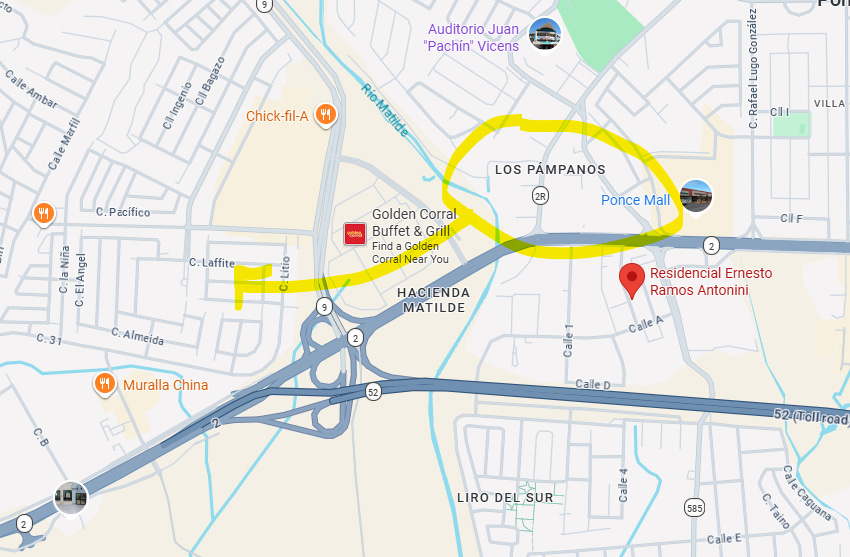
And, would you look at that, there’s a Calle Laffite. One of those small streets connecting to Calle Laffite was called Calle Cofresi. Cofresi was a famous Puerto Rican pirate. From Wikipedia:
Cofresí began his new career in early 1823, filling a role vacant in the Spanish Main since the [possible, unconfirmed] death of Jean Lafitte, and was the last major target of West Indies anti-piracy operations.
My friends, this is no coincidence.
I didn’t find any other smoking guns in the street names of Ponce, but I have a lot more new information to share besides that. I have kind of been on a roll over here. 😂
A friend mentioned the other day to me that she had found the will of Honoré Fortier on a Puerto Rican genealogy site I’d never looked at before. So I immediately went and joined the site to see what else they had in there.
Interestingly, there were only a handful of wills in the site’s collection, but two of them were relevant names: Honoré Fortier and Louis Alexandre Harang.
To recap why these people are relevant: Louis Alexandre Harang was a New Orleans native who leased Los Pámpanos, Pedro Gautier’s estate, after Pedro’s death. Honoré Fortier was Harang’s brother-in-law and business associate. He was also the former owner of this property:
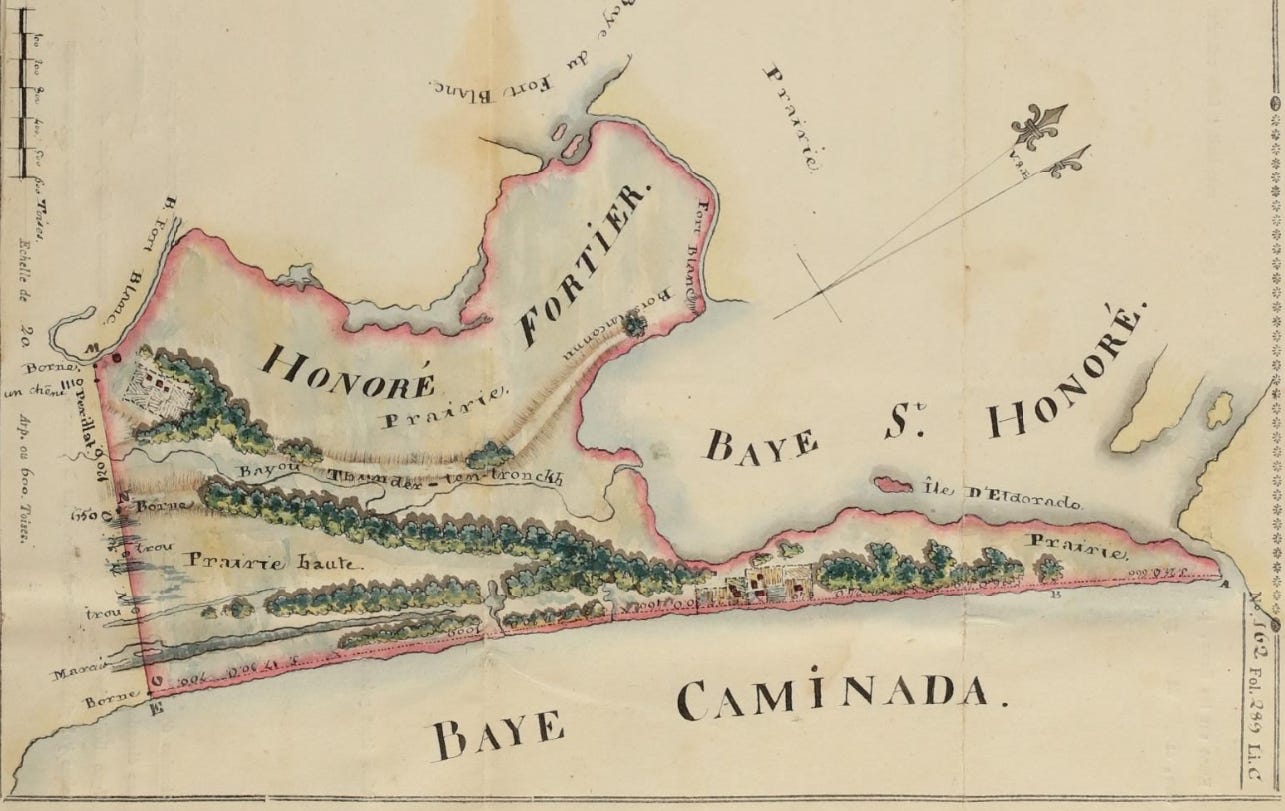
That is quite literally where the Laffites had their base of operations in Barataria. This map is from a letter Honoré sent to Edward Livingston in 1809 or so, related to selling that property. This was just a year or so after Honoré was involved in a trial for smuggling, in which Livingston represented him as his attorney.
I would also like to recall that Edward Livingston was a next-door neighbor of the Pierre Gautier who lived in Plaquemines Parish. And that decades after Pierre’s death in 1805, Genevieve Zulime Gaultier of Cap Tiburon, Saint-Domingue, claimed what appears to be Pierre’s property, claiming that her family had held the property for more than 40 years. Genevieve and her immediate family were not in Louisiana until around a decade after Pierre’s death in 1805, and it had not been 40 years since they arrived when she made this claim.

Okay! So what is my point in going over all this? Well, I have been following all of these different groups of people who I for one reason or another suspected were related to my mystery for a long time. At first I couldn’t connect them all to each other at all, but as time goes on the connections I’m finding among these disparate groups are getting reinforced in new ways over and over. Plaquemines Pierre Gautier is connected to the Cap Tiburon Gaultiers. He is connected to Livingston. Livingston is connected to Honoré Fortier, who is connected to Harang, who is connected to Pedro Gautier in Ponce. The number of hops between all of them is steadily decreasing. I will show you what I mean.
Louis Alexandre Harang’s will (1829) includes this item:
I declare that I have the following debts against me: I owe Madame Doña María Juana Gautier, widow of Don Juan Bautista Blancherau, of this neighborhood, the sum of four hundred and some pesos, which are due to her for the third year of the lease of the Los Pampanos estate…
Maria Juana Gautier was the daughter of Pedro Gautier and an unknown woman of color. I know this thanks to one of her descendants who contacted me awhile ago about the Gautier mysteries. 😊 So although Pedro’s other known (legitimate) daughters had all moved to France shortly after their father died, Maria Juana was still in Ponce collecting rent on her father’s estate from Harang.
Another exciting find on the Puerto Rican genealogy site was an 1827 census of “Barrio Quemado” in Ponce. The other hacienda Pedro Gautier was associated with was called Hacienda Quemado; presumably this is the same geographic area. This census is fascinating for a lot of reasons… especially interesting is that essentially every family I’ve ever researched because they had connections to both Louisiana and Puerto Rico is found in this one area. But I want to focus on two specific neighboring households.
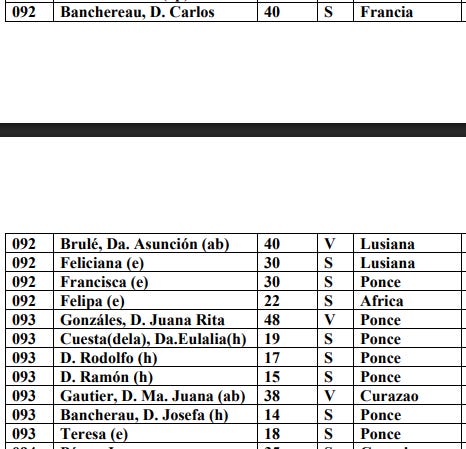
So there’s Maria Juana Gautier in household #93. She was widowed by this time, 38 years old. And an exciting new lead: Maria Juana was born in Curaçao!! This is new information. And it means that Pedro Gautier was probably in Curaçao around 1789. Curiouser and curiouser.
But—check out household #92. I wouldn’t have recognized any of these people if I saw this several months ago, but today I recognize them. Asunción Brulé of Louisiana was the widow of Honoré Fortier. And she was living in the household of one Carlos Banchereau of France. Maria Juana Gautier was the widow of Juan Bautista Banchereau. Banchereau (sometimes written as Blanchereau) is a really uncommon name, and my suspicion is that Carlos and Juan Bautista were brothers. There is undoubtedly a connection there. So the circle tightens just a bit more…
Now I want to take a quick detour to tell you about some other tidbits I have recently gleaned from newspapers related to Asunción Brulé and Carlos Banchereau.
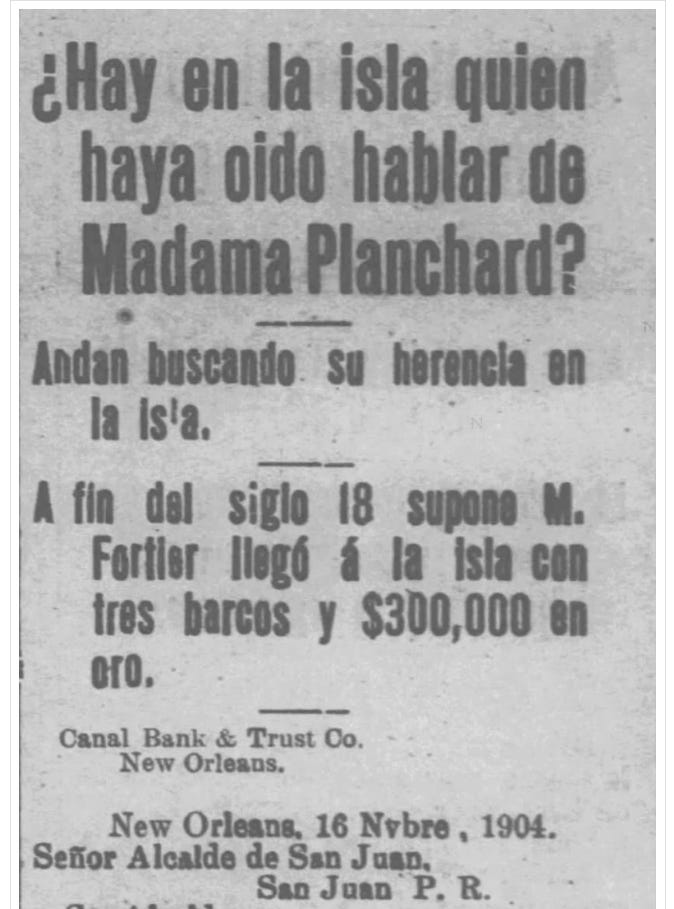
This ad was published in San Juan newspapers in 1904 by one Michel J. Fortier of New Orleans. A translation of this article:
Is there anyone on the island who has heard of Madame Planchard?
They are looking for her inheritance on the island.
At the end of the 18th century, it is assumed that Mr. Fortier arrived on the island with three ships and $300,000 in gold.
New Orleans, November 16, 1904
Mr. Mayor of San Juan, P. R.
Mr. Mayor: Could you please inform me about a Mrs. Planchard who died in San Juan, Puerto Rico, about 25 years ago?
She was married first to François Honoré Fortier and secondly to Mr. Honoré Planchard, who died before her. Later, in a newspaper article, you say that she died without heirs, leaving a large fortune.
At the end of the eighteenth century or beginning of the nineteenth, a Mr. Honoré Fortier left New Orleans with $300,000 in gold and three ships belonging to him. Nothing more has been heard of him, and it is assumed that he settled in the Antilles. The assumption is that this fortune left by Madame Planchard came from him. Therefore, the Fortiers of New Orleans will be his heirs.
Is it possible to know if Honoré Fortier, husband of Madame Planchard, has any descendants? Did Madame Planchard leave a will? If the Fortiers are her heirs, what steps should be taken, and to whom should they be addressed?
I am writing this letter on the advice of the Foreign Consul of Spain in New Orleans. I am also writing to the Foreign Consul of Spain in San Juan. Please accept, Mr. Mayor, the expression of my most distinguished sentiments.
Michael J. Fortier
In combination with several other articles published in New Orleans around this time, the picture becomes much clearer.
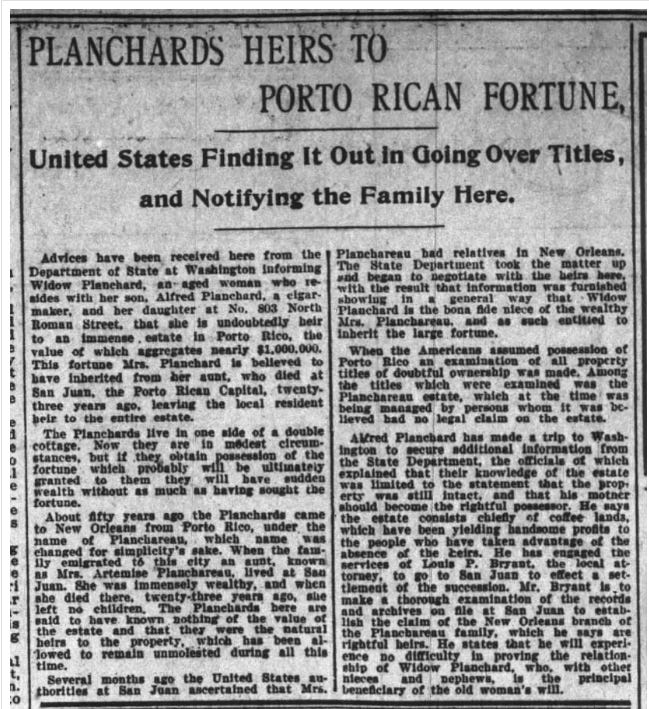
I’ll highlight the most relevant part:
“About fifty years ago the Planchards came to New Orleans from Porto Rico, under the name of Planchareau, which name was changed for simplicity’s sake. When the family emigrated to this city an aunt, known as Mrs. Arthemise Planchareau, lived at San Juan. She was immensely wealthy, and when she died there, twenty-three years ago, she left no children.”
Another article was then published retracting the claims that the Planchards in New Orleans were due any fortune in Puerto Rico.
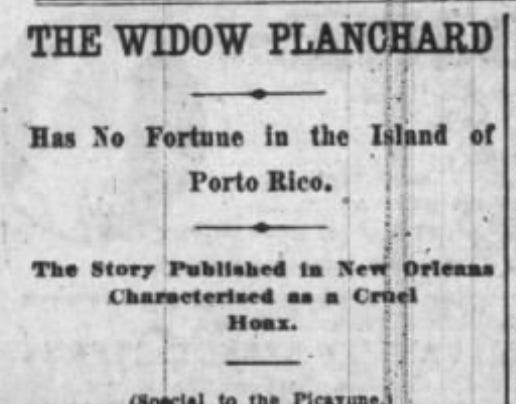
Why would someone come up with this hoax? I have no idea. But this article clarifies some things.
Arthemise was a family nickname, her true name being Maria Asunsion Brule. She was married to Francisco Honorato Fortier, who died some forty or fifty years ago. She had by him a son, named Agustin Alfredo Fortier. She again married Carlos Blanchereau, who died a short time afterwards, and she herself died about thirty-five or thirty-six years ago. Her son Agustin Alfredo Fortier inherited the little property that she left, which is believed to be a small house and lot on Villa Street, and no other property is known of. She supported herself by making sweetmeats, jellies, etc., for sale to the people. This information has been obtained from relatives of her first husband, Francisco Honorato Fortier.
Although the first two articles had many details confused, this last one gets them right. Asunción Brulé remarried to Carlos Blanchereau after her first husband’s death. I have no idea why anyone thought the New Orleans Planchards would be due any fortune left by Honoré, because he and Asunción have many descendants in Puerto Rico via their son Agustin Alfredo. I would imagine the Fortiers in New Orleans thought they might be able to claim by showing that none of Honoré’s descendants were “legitimate”, but I’m not so sure they were considered illegitimate in Puerto Rico just because they were the product of a mixed race union. These sorts of laws varied a lot by both time and place.
In any case, Honoré’s will indicates that he left no fortune.
I declare that when I got married I had assets worth more than twenty-five thousand pesos, and today I only own half of the cotton gin located on Marina Street, on a plot of land approximately one acre in size, and the other half of said gin belongs to Mr. José Garrus.
His will was written in 1823 in Ponce, only a few years after he had moved his family there. It’s unclear what happened to all the money he had when he arrived. The only heir mentioned in his will is his son Agustin; there’s no mention at all of the numerous children he fathered in New Orleans with Adelaide Lalande. However, I located a letter from their son Juan related to his mother’s estate that was written from Ponce in 1819, so it’s not like Honoré completely disappeared and abandoned the rest of his kids when he went to Puerto Rico; it’s possible that most or all of them died quite young. He had at least 5 children with Adelaide Lalande and two other known kids with Asunción Brulé. Perhaps he arranged for his other kids in some less-official manner.
Asunción Brulé was supposed to be the grand-aunt of the “widow Planchard” in New Orleans. I haven’t yet worked out the exact connections there, but I believe she was a woman of color named Marie Francoise Francis or Lacroux/Lacroix.
So where does all of this leave me? Well, I have a bunch of new leads to follow from all of these new sources. And a feeling that this group of people is starting to coalesce in my mind; plausible configurations for how it all fits together are beginning to become easier to imagine.
I feel like I have come a really long way from where I was when I first found the article about my ancestor Pierre Gautier paddling the article’s author down Bayou Terrebonne in 1836. In that article, Pierre was described as French Canadian. The reality was apparently far more complicated and interesting than that. And… it seems less and less likely that it was just an impersonal bit of trivia he shared regarding the “pirate house”.
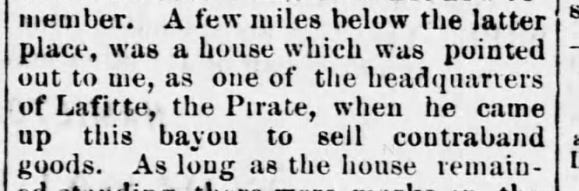
Who was he actually? One of these days I’m going to find out for sure… 😊
Honore is my 3rd cousin, 7x removed...pirate and slaveholder? Man of mystery. Tied up somehow with your Pierre Gaultier. And what a rich story is unfolding here. I'm trying to puzzle out race relations from the time...here you have a white FC guy and a fpoc having children, but also owning slaves. Need to mull and ponder on that. Great job, cuz!
Great job uncovering this history.